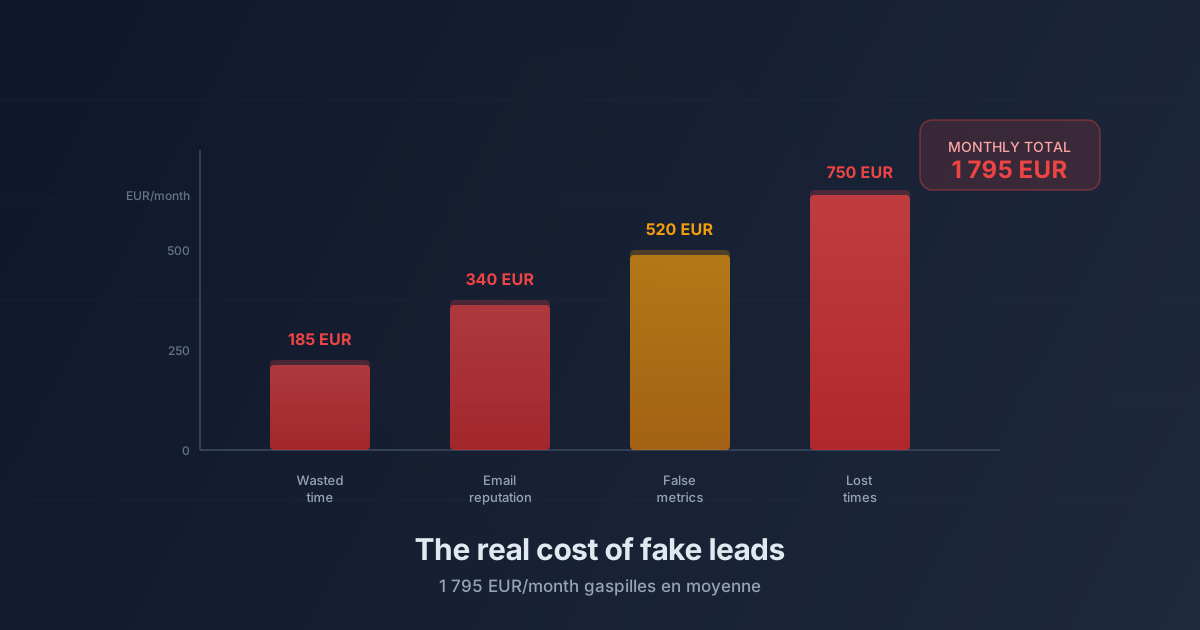
You thought form spam was just annoying? It’s costing you money.
Opening your CRM in the morning and finding fifteen new submissions. Fifteen potential contacts. Fifteen opportunities. Except twelve of them are bots, curious competitors, or forms randomly filled by automated scripts.
You sigh, delete, and move on. And you do it all over again the next day.
Thousands of freelancers, tradespeople, and small businesses live this scenario every day. Form spam has become so common that it’s treated as inevitable. We tolerate it. We get used to it. We mentally accept it as part of the digital landscape.
That’s a mistake. A costly one.
Because fake leads aren’t just an annoyance. They have a real, measurable cost that most businesses never calculate — and silently pay for, month after month.
Here’s how to quantify that cost, and how to put an end to it.
The 4 hidden costs of fake leads
1. Wasted time on sorting
It’s the most obvious cost, and therefore the most frequently underestimated.
Every form submission requires minimum processing: read the message, assess whether the contact is real, attempt a callback or qualification email, discover the person doesn’t exist or never responds, archive or delete.
Be honest. Even two minutes per spam lead adds up enormously over a month.
A form receiving 30 spam submissions per month generates an average of 1 hour of wasted work each month — that’s 12 hours per year.
For a freelancer billing $80 per hour, that’s $960 worth of work swallowed into nothingness. Every year. Without producing a single cent of revenue.
And this figure doesn’t account for the mental cost: frustration, demotivation, loss of focus with every interruption.
2. Degraded email reputation
This is the most insidious cost, because it’s invisible until the day it becomes catastrophic.
When your system automatically sends a confirmation or welcome email for every new submission, you’re bombarding nonexistent or invalid addresses. Mail servers know this. They measure your bounce rate, spam rate, and unsubscribe rate.
Beyond a certain threshold, Gmail, Outlook, and Yahoo algorithms start downgrading your emails. First to promotional tabs. Then to spam. Then to oblivion.
A bounce rate above 2% is enough for your domain to be penalized by major email providers.
Result: your real prospects no longer receive your emails. Not in their primary inbox. Not necessarily in their spam folder either. Nowhere.
Rebuilding a degraded email reputation takes weeks, sometimes months. And during that time, every sales email you send is partially or completely neutralized.
3. False metrics that distort your decisions
Your dashboard shows 150 leads this month. Great. Your conversion rate is 3%. Disappointing.
Except 90 of those 150 leads are bots. Your real conversion rate is actually 19%. Your sales performance is much better than you think. But you don’t know it.
This data distortion has concrete consequences on your decisions:
- You think your form doesn’t convert, when it’s your filtering that’s failing
- You invest in an ad campaign to “compensate for weak leads,” which attracts even more bots
- You conclude your offer doesn’t appeal to the market, when the signal is polluted
Data corrupted by spam produces bad strategic decisions — often more expensive than the spam itself.
The quality of your data is the foundation of your sales management. Distorted metrics are like a faulty radar on an aircraft.
4. Opportunity cost: real leads drowned in noise
Imagine a real prospect — someone who searched for your service, visited your site, took time to fill out your form with a genuine question, a real project, and a real budget. This prospect deserves a fast, personalized, professional response.
They don’t get one.
Because their submission is buried under a pile of fake leads. Because you spent your morning sorting spam. Because you took twelve hours to call them back instead of one. Because by then, they’d already contacted your competitor.
Studies show a prospect contacted within the hour after submission is 7 times more likely to convert than one contacted 24 hours later.
The true cost of fake leads isn’t just what they directly make you lose. It’s also what they prevent you from earning.
Calculate your monthly spam cost
Use this table to estimate what fake leads truly cost you each month.
| Parameter | Your value | Example |
|---|---|---|
| Total submissions per month | … | 80 |
| Estimated spam percentage | … % | 60% |
| Number of fake leads per month | (A x B) | 48 |
| Processing time per fake lead | … min | 2 min |
| Total time wasted per month | (C x D) | 96 min |
| Your hourly rate or value of time | … $ | $75 |
| Direct monthly cost (time) | (E / 60 x F) | $120 |
| Auto-emails sent to invalid addresses | … | 48 |
| Estimated deliverability degradation cost (monthly) | estimate | $50 - $200 |
| Real leads missed or handled too late | … | 3 |
| Average client value | … $ | $500 |
| Estimated monthly opportunity cost | (K x L) | $1,500 |
Estimated monthly total: between $200 and $2,000 depending on your business.
This isn’t a theoretical figure. It’s money going up in smoke, silently, every month.
3 signals showing you have a spam problem
You’re not always aware of the problem’s extent. Here are three concrete indicators that should alert you.
Signal 1: Your email open rate is progressively collapsing. If your sales emails used to get 40% open rates a year ago and now cap at 15%, your sender reputation is probably the cause. Repeated bounces have started weighing you down.
Signal 2: Your leads never respond, even qualified ones. When you try to reach your prospects, nobody answers. Numbers don’t exist, emails bounce, addresses are generic. It’s a sign that your submissions are predominantly fraudulent.
Signal 3: Your conversion metrics are inconsistent with your actual business. You’re closing deals, you have satisfied clients, your business is running — but your dashboard shows a ridiculously low conversion rate. The most likely explanation: your denominator (the number of “leads”) is inflated by spam.
What businesses that solved the problem actually did
Companies that took the problem seriously didn’t just “delete spam by hand.” They acted at the source.
They first audited their lead flow: how many submissions actually arrive each month, what proportion is qualified, at what point in the journey bots infiltrate.
They then implemented technical barriers adapted to their volume and audience. Not necessarily the most complex — the most effective. A well-configured honeypot eliminates 80% of bots with no friction for real users. An AI-based filter goes even further, detecting suspicious patterns that bots reproduce predictably.
For more on this topic, our article on the honeypot, CAPTCHA, and AI comparison details the available solutions and their optimal use conditions.
They finally cleaned their historical data: removing obviously invalid contacts from their databases, purging addresses that never respond, and restarting with reliable metrics.
The result is immediate: less noise, more signal. Sales time is reallocated to real prospects. Emails reach their destination. Decisions become rational again.
How Prospect Hub eliminates fake leads at the source
Prospect Hub natively integrates a form submission filtering system, designed for freelancers and small businesses without a dedicated IT department.
Specifically, every incoming submission is automatically analyzed. HiveProtect technology measures user behavior in real time (mouse movements, typing speed, keyboard interactions), while AI analyzes message content. Bot-characteristic patterns — abnormal fill speed, suspicious fields, disposable addresses, repetitive behaviors — are detected and isolated before they reach your pipeline.
You only see real leads. Your CRM stays clean. Your metrics are reliable.
The system integrates directly with your existing forms, with no specific development required. Our guide on how to integrate your web forms explains the procedure step by step.
To understand the mechanics behind detection — and why AI outperforms traditional approaches — check out our dedicated article on form spam and AI.
The real problem isn’t spam. It’s tolerating it.
Bots and fake leads aren’t going away. Spam techniques evolve constantly, adapting to filters and bypassing protections. That’s a reality of the web in 2026.
But tolerating the problem while hoping it resolves itself means funding an invisible expense item every month that produces nothing.
The right approach isn’t spending more time sorting. It’s never having to sort at all.
If you also want to avoid commercial errors downstream — once real leads are identified — our guide on the 7 prospecting mistakes will give you the keys to maximize conversions on qualified contacts.
Ready to stop paying for leads that don’t exist?
Prospect Hub lets you collect, filter, and track your prospects from a single interface, built for professionals who work alone or in small teams. Zero fake leads in your pipeline. Zero time wasted sorting. Only real opportunities, ready to be worked.
Try for free — no credit card, no commitment.