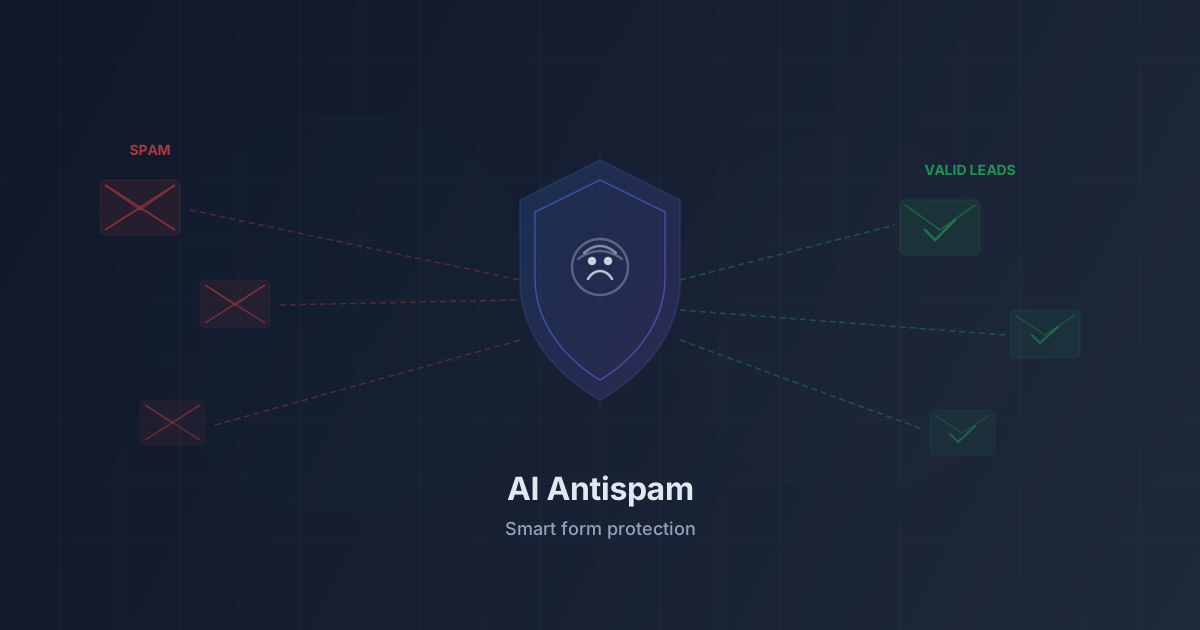
Your contact form is lying to you
You look at your CRM dashboard this morning. Ten new leads received overnight. You open the records, ready to make the first calls. And then: three messages in Chinese for dubious SEO services, two submissions with emails like test@test.com, one form filled repeatedly with the same message 47 times, and a prospect whose name is “Buy cheap Instagram followers.”
You’re left with four leads to process. Maybe.
Every website owner knows this scenario. And it gets worse year after year.
45% of global internet traffic comes from bots in 2026, according to the Imperva Bad Bot Report. On contact forms, the rate of automated submissions now exceeds 60% on unprotected sites.
Form spam isn’t a minor nuisance. It’s a structural problem that pollutes your data, wastes your team’s time, and can distort all your business decisions if you’re not careful.
Why CAPTCHAs are no longer enough in 2026
For years, CAPTCHA was the universal answer to spam. “Are you a human? Identify the traffic lights in these images.” Simple, effective… once upon a time.
Those days are over.
Click farm networks employ thousands of human workers in low-cost countries to solve CAPTCHAs manually. The cost for a spammer to pass 1,000 CAPTCHAs is a few dollars. And automated solutions based on computer vision now solve reCAPTCHA v2 with a success rate exceeding 90%.
A CAPTCHA solving service costs between $0.50 and $2 per 1,000 solves. For a spammer sending 10,000 forms daily, the anti-detection budget is negligible.
But the CAPTCHA problem goes beyond circumvention. There’s a direct cost to user experience.
Degraded UX, the silent enemy of conversions
Every friction added to a form reduces conversions. The numbers are clear:
| Protection type | Form abandonment rate | Spam blocked |
|---|---|---|
| No protection | 12% | 0% |
| CAPTCHA v2 (images) | 27% | 45% |
| reCAPTCHA v3 (score) | 14% | 62% |
| Honeypot alone | 12% | 55% |
| Behavioral AI | 12% | 94% |
A legitimate visitor — your future client — who stumbles on an illegible CAPTCHA or has to click on six bicycle images has a 15% higher chance of abandoning the form. You’ve lost a real prospect to filter out a bot.
That’s the CAPTCHA paradox: it penalizes humans without discouraging machines.
The AI approach: analyze content, don’t block humans
The conceptual breakthrough of artificial intelligence applied to anti-spam is the paradigm shift: instead of putting obstacles in front of everyone, you let everyone through and analyze what’s submitted.
A bot can solve a CAPTCHA. It cannot, however, write a coherent, contextually relevant message with a credible commercial intent and a natural writing style. At least not without betraying itself through other signals.
AI doesn’t ask the user to prove they’re human. It determines this itself, silently, by reading what they write.
What AI sees that you don’t
A spam message like “Hello I am looking for your services to develop my professional website thank you” seems legitimate at first glance. A distracted human might process it seriously.
But a language model trained on millions of submissions detects in milliseconds:
- The generic phrasing applicable to any industry
- The absence of contextual details that characterize a real request
- The syntactic structure identical to thousands of previously seen messages
- The inconsistency between message content and provided contact information
- The abnormal timing and typing behavior
What AI analyzes is meaning, coherence, and intent — dimensions inaccessible to rule-based filters.
How protection works in Prospect Hub
Prospect Hub’s anti-spam protection relies on a 9-layer progressive architecture. The first six operate upstream, with no AI cost. The last three trigger artificial intelligence analysis.
Layers 1 to 6: perimeter defense
Before AI intervenes, six filters eliminate the most obvious cases:
Layer 1 — Data validation: format verification (valid email, coherent phone number, required fields present). Eliminates empty or obviously malformed submissions.
Layer 2 — Honeypot: a hidden field is slipped into the form. No human sees it, no human fills it. A bot scanning the DOM fills it automatically and gives itself away. Effective against 40% of basic bots.
Layer 3 — Rate limiting: if the same IP submits more than N forms in Y minutes, it’s temporarily blocked. Protects against volume attacks.
Layer 4 — HiveProtect: browser behavioral fingerprint — mouse movements, typing speed, focus sequence between fields. A bot that fills a form in 0.3 seconds without moving the mouse doesn’t look human. HiveProtect detects this in real time, before the message is even analyzed by AI.
Layer 5 — Heuristic analysis: business rules on content. Blacklists of disposable email domains, known spam patterns, suspicious URLs in the message.
Layer 6 — IP reputation: checking against databases of IP addresses known for spam, botnets, or anonymization proxy servers.
These six layers eliminate the vast majority of raw spam. But they hit a fundamental limit: they don’t understand natural language. That’s where layers 7, 8, and 9 come in.
Layers 7, 8, and 9: AI analysis
When a submission passes the first six filters without being blocked but presents ambiguous signals, it’s submitted to analysis by Anthropic’s Claude model.
Layer 7 — AI content analysis: the complete message is sent to the Claude API with enriched context (site nature, industry, history of legitimate submissions). The model evaluates the probability that the message is spam, a generic automated message, or a real business inquiry. It returns a structured verdict: legitimate, spam, uncertain, with a confidence level.
Layer 8 — Cached spam detection: if the same message (or a close variant) has already been analyzed and classified as spam, the result is retrieved from cache without running a full analysis. This mechanism reduces AI costs by 60 to 70% on repetitive spam campaigns that send identical messages to thousands of forms.
Layer 9 — AI repeat offenders: a sender whose multiple submissions have already been classified as spam has all future submissions treated directly as spam, with no further analysis. The repeat offender profile is built progressively and maintained in real time.
The spam types detected by this system are precisely categorized: ai_spam (spam detected by direct analysis), ai_cached_spam (variant of already-identified spam), ai_repeat_offender (known repeat offender).
API key security
The Anthropic API key powering AI analysis is stored encrypted in AES-256-GCM. It’s never exposed in plaintext in the database or logs. Only the analysis process accesses it at request time, after in-memory decryption.
Concrete results: what you gain
The legitimate question is the real bottom line. Here are the metrics observed on forms connected to Prospect Hub with AI protection activated.
Detection rate and false positives
94% of spam submissions are blocked with all 9 layers active. The false positive rate — legitimate messages incorrectly blocked — is below 0.3%.
This 0.3% false positive figure is the most important metric. A system that blocks 99% of spam but generates 5% false positives is unusable in practice: you’ll lose real prospects.
AI analysis provides precisely what static rules cannot offer: nuance. A short, vague message isn’t automatically spam — some prospects simply write “Hello, I’d like a quote.” The model considers the full context before deciding.
Real-time cost tracking
AI analysis isn’t free: each Claude API call has a token cost. The Prospect Hub dashboard displays in real time the number of tokens consumed and the estimated cost of AI protection, hour by hour and day by day.
This tracking enables configuration optimization: if your form receives few submissions, AI can analyze all ambiguous submissions. If your site is under attack receiving thousands of submissions per hour, rate limiting and cache absorb the load without exploding the bill.
Comparison table: CAPTCHA, honeypot, or AI?
| Criterion | CAPTCHA | Honeypot alone | AI (9 layers) |
|---|---|---|---|
| Detection rate | 45 to 70% | 50 to 60% | 90 to 94% |
| False positives | 2 to 5% | 0.5% | < 0.3% |
| UX impact | High (visible friction) | None | None |
| Resistance to sophisticated bots | Low | Medium | High |
| Resistance to “human” spam | None | None | High |
| Operating cost | None | None | Variable (tokens) |
| Configuration | Simple | Simple | Intermediate |
| Semantic analysis | No | No | Yes |
The “human spam” column is important. Click farms employ real people who manually fill contact forms to send spam. Neither CAPTCHA (which they solve) nor honeypot (which they ignore since they use the real form) stops them. Only semantic content analysis can identify these submissions for what they are.
How to activate AI protection on your form
Activation takes three steps from your Prospect Hub dashboard.
Step 1: Enter your Anthropic API key
In Settings > Integrations > AI Protection, paste your Anthropic API key (format sk-ant-xxxxx). It’s encrypted immediately upon saving. You can get one at console.anthropic.com.
Step 2: Activate protection with a toggle
A simple switch enables or disables AI analysis. Layers 1 through 6 remain always active regardless of this setting.
Step 3: Describe your site context
This is the often-neglected step, yet the most decisive for analysis accuracy.
The “site context” field lets you tell the model what your business does, what types of requests are legitimate, and what signals should raise suspicion. For example:
- “Plumbing business in the Paris area. Legitimate requests are about repairs, bathroom renovations, and leaks.”
- “B2B communications agency. Prospects are marketing directors of SMBs. Off-topic messages or inbound service proposals are spam.”
The more precise this context, the more the model has to distinguish a real request from a generic message. It’s the difference between a blind filter and a collaborator who understands your business.
Once configured, the system works in complete autonomy. Every submission received via your form integrated with Prospect Hub passes through all layers. Legitimate leads arrive in your pipeline, spam is silently blocked, with no friction for your visitors.
You can view in your dashboard the history of blocked submissions, the blocking reason (honeypot, rate limiting, ai_spam, etc.), and weekly protection statistics.
Spam isn’t just a technical problem
Form spam is often thought of as a technical issue. In reality, it’s a data problem.
Every fake lead that enters your CRM degrades your database quality. It distorts your conversion statistics. It wastes your team’s time on manual sorting. It pollutes your lead scoring analyses if you use automatic qualification systems. And over time, it erodes the trust you place in your own tool.
A CRM with reliable data is worth ten times more than a CRM half-filled with noise.
A lead database polluted with 30% spam reduces the sales team’s effectiveness by 40%, according to a Salesforce study on CRM data quality. This isn’t a marginal problem.
AI protection isn’t a technical option for security enthusiasts. It’s a condition for reliable business data.
Conclusion
Form spam has evolved faster than classic defenses. Bots have become capable of solving CAPTCHAs, simulating human behaviors, and writing messages coherent enough to fool keyword filters.
The only response matching this evolution is semantic analysis by artificial intelligence: understanding what the message says, in context, and deciding whether it’s real.
Prospect Hub integrates this protection directly into the lead reception pipeline. No third-party plugin to install, no complex configuration, no user experience degradation. Protection activates, the form stays simple and fast for your visitors, and only real prospects reach your CRM.
Your leads deserve to be reliable. Your time deserves to be spent on prospecting, not sorting.
Create your free Prospect Hub account and activate AI protection today.
Remember:
- In 2026, over 60% of unprotected form submissions are spam or bots
- CAPTCHAs are bypassable and degrade the UX of real prospects
- Prospect Hub uses 9 protection layers, including 3 powered by Anthropic’s Claude AI
- Semantic analysis detects spam that classic rules can’t see
- The false positive rate is below 0.3%: your real leads are never blocked
- AI cost is tracked in real time and optimized by intelligent caching
- A CRM with reliable data is the foundation of effective prospecting